
Changes Affecting Ontario Landlords Coming into Force on July 1, 2026
Part I
On June 8, 2023, the Helping Homebuyers, Protecting Tenants Act, 2023 (the “Act”) received Royal Assent. Among other amendments, the law provides for amendments to the Residential Tenancies Act, 2006 (“RTA”). Despite the Act receiving Royal Assent in 2023, none of those amendments have yet come into force. The provincial government has now announced that many of the amendments that the Act makes to the RTA will come into force on July 1, 2026. In this article, the landlord’s legal team at Gobin & Leyenson LLP identifies one of the changes that become law on July 1, 2026, and explains how it affects residential landlords in Ontario. Follow us on social media to learn more and empower yourself as a residential landlord to make informed decisions about your rental investment property.
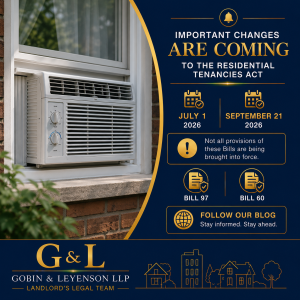
Air conditioning changes are coming on July 1, 2026 to the residential landlord law.
Right to Install an Air Conditioner in a Rental Unit
Starting July 1, 2026, tenants may install and use an air conditioner inside their rental unit, provided the landlord does not already supply air conditioning. The air conditioner may be a window unit or a portable unit. These changes will not apply to rental units in a mobile home park or in a land lease community.
The legislative changes do not give a tenant a carte blanche to install an air conditioner. If the landlord is responsible for paying for the rental unit’s electricity, the tenant must meet all of the following conditions:
- The tenant must notify the landlord, in writing, of the tenant’s intention to install or use the air conditioner.
- If the landlord pays for the electricity in the rental unit, the tenant must also give the landlord details about the air conditioner’s energy efficiency and the tenant’s expected usage.
- The tenant must make sure the installation and usage of the air conditioner does not damage the rental unit or the residential complex.
- The air conditioner must be installed safely and securely.
- The tenant must ensure the installation of the air conditioner is permitted by any applicable municipal property standards by-law, or any other applicable laws in relation to the rental unit or the residential complex. In other words, the municipal or the condominium by-laws do not prohibit the installation of such air conditioner unit.
- The tenant must ensure the air conditioner is installed and maintained in accordance with any applicable laws.
- Finally, additional conditions may apply in the future if the province prescribes them by way of additional regulations. The tenant must comply with those conditions as well.
Pre-Existing Air Conditioner
If a tenant installed a window or portable air conditioner before July 1, 2026, and the landlord is paying for the electricity of that rental unit, the new rules also apply. Specifically, the following conditions must be met:
- The tenant must make sure the installation and usage of the air conditioner does not damage the rental unit or the residential complex;
- The air conditioner must be installed safely and securely;
- The tenant must ensure the installation of the air conditioner is permitted by any applicable municipal property standards by-law, or any other applicable laws in relation to the rental unit or the residential complex. In other words, the municipal or the condominium by-laws do not prohibit the installation of such air conditioner unit.
- The tenant must ensure the air conditioner is installed and maintained in accordance with any applicable laws.
- As in the case of post-July 1, 2026 air conditioners, additional requirements that are not yet known may be prescribed by regulation.
When comparing the two scenarios, one will find that, in the second scenario, where the air conditioner was installed prior to July 1, 2026, two key requirements do not apply. Firstly, the tenant does not need to notify the landlord in writing, and secondly, the tenant does not need to provide any details about the air conditioner’s energy efficiency or usage.
What Are the Landlord’s Rights and Obligations?
In certain prescribed circumstances, a landlord may prohibit a tenant from installing an air conditioner. However, as of now, neither the Act nor the RTA defines those circumstances. Therefore, landlords should not assume they have the right to block a tenant from installing or using an air conditioner. At this time, the law does not give landlords that right.
Rent Increase due to Air Conditioner
When a tenant installs an air conditioner in a rental unit where the landlord pays for electricity, the landlord may raise the rent. However, this right applies only if the tenant installed the unit on or after July 1, 2026. In other words, if the tenant installed an air conditioner before that date, the landlord cannot raise the rent for it.
Note also that if the lease agreement states that installing an air conditioner will not raise the rent, the landlord cannot increase the rent — even if the tenant installs the unit on or after July 1, 2026. The landlord may only raise the rent by the actual cost of running the air conditioner. If the landlord cannot determine the exact cost, a reasonable estimate is acceptable. The landlord calculates that estimate using the energy efficiency details and usage information the tenant provides.
Once the landlord raises the rent for the air conditioner, the obligation to lower it also applies. If the tenant removes the unit, the landlord must reduce the rent by the same amount. Similarly, even if the tenant simply stops using the air conditioner for part of the year — for example, during winter — the landlord must lower the rent for that period. Conversely, if the tenant starts using the air conditioner again — for example, during the summer months — the landlord may raise the rent once more, based on the actual cost or a reasonable estimate.
How This Rent Increase Differs from Normal Rules
This air conditioning rent increase works differently from all other rent increases under the RTA. As a result, the landlord may raise or lower the rent for the air conditioner more than once every 12 months. The landlord also does not need to give 90 days’ advance notice and does not need the approval of the Landlord and Tenant Board (“LTB”). Furthermore, the air conditioning rent increase sits above the annual provincial rent increase guideline where that guideline applies. In other words, it does not affect the maximum allowable increase in rent that a landlord may impose under other provisions of the RTA.
Moreover, even if an LTB order currently stops the landlord from raising rent on a rental unit — for example, because the landlord has not yet completed required repairs or complied with work orders — that order does not block the air conditioning rent increase. The landlord may still apply it.
Inspection of the Rental Unit due to Air Conditioner
To verify compliance, the landlord may inspect the rental unit. The landlord must first give the tenant written advance notice in accordance with s. 27 of the RTA. During the inspection, the landlord may check that the tenant installed and operates the air conditioner without damaging the rental unit or the building, that the tenant installed it safely and securely, and that the installation and use comply with all municipal and other applicable laws.
Disclaimer
Landlord legal team at Gobin & Leyenson LLP invites you to follow us on social media, and stay updated on the changes and new cases which impact residential landlords in Ontario. This article provides general information only. It is not legal advice. Contact Gobin & Leyenson LLP for advice specific to your situation.