
The Ontario government recently announced that the annual rent increase guideline for 2027 will be 1.9%.¹ Whenever the annual guideline is announced, many residential landlords immediately ask the same question:
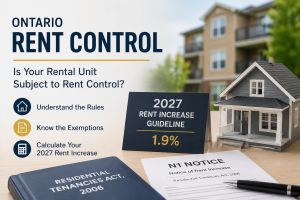
Ontario’s 2027 rent increase guideline is 1.9%, but not every rental unit is subject to rent control. Understanding the exemption rules is essential before serving an N1 Notice.
Does this apply to my rental property?
The answer is not always straightforward. While many residential rental units in Ontario are subject to rent control, others are exempt from the annual rent increase guideline. Determining whether a rental unit is exempt requires a careful review of the Residential Tenancies Act, 2006 (“RTA”) and the specific circumstances of the rental unit.
Serving the wrong notice, applying the wrong rent increase, or assuming that a rental unit is exempt from rent control when it is not may result in unnecessary disputes before the Landlord and Tenant Board (“LTB”). Understanding Ontario’s rent control framework before serving an N1 Notice may help landlords avoid costly mistakes.
Why This Issue Matters
Rent increases affect virtually every residential landlord in Ontario. For many landlords, annual rent increases help offset increasing costs associated with:
- Property taxes;
- Insurance;
- Mortgage interest;
- Utilities;
- Maintenance; and
- General inflation.
However, the amount by which rent may be increased depends on whether the rental unit is subject to Ontario’s rent control provisions. Some landlords mistakenly assume that because they purchased a property recently, completed renovations, or created a new tenancy, the rental unit is automatically exempt from rent control. That is not necessarily the case. Before deciding how much rent may be increased, landlords should first determine whether the annual rent increase guideline applies to their rental unit.
Understanding Ontario Rent Control
The Residential Tenancies Act limits annual rent increases for many residential rental units through the rent increase guideline established by the Province each year.² For 2027, the Province has established the annual rent increase guideline at 1.9%.¹
Where a rental unit is subject to rent control, landlords are required to:
- Wait at least 12 months before increasing the rent, since the last increase occurred or since the date the tenancy commenced. In other words, rent increase cannot occur earlier than one year anniversary of the tenancy or the last time the rent was increased.
- Landlords must provide written notice to the tenant, announcing the rent increase. The notice must be delivered to the tenant at least 90 days before the date on which the increase will occur, utilizing the prescribed form.
- The increase cannot be higher than the annual provincial guideline, unless:
- The rental unit is exempt from rent control;
- The landlord obtained advanced permission from the Landlord and Tenant Board, through the Above Guideline Rent Increase application;
- The landlord and the tenant agree on a higher amount, the agreement is in writing, and the tenant agreed without pressure or coercion
These requirements apply regardless of whether the landlord recently purchased the property or whether the tenancy has changed ownership. Rent control applies to most rental units, such as single-family homes, apartments, basement apartments, condominiums, care homes, mobile homes, and land lease communities.
Example: Calculating a 2027 Rent Increase
Assume the following:
· Current monthly rent: $2,000.00
· Rental unit is subject to Ontario’s rent control rules
· The last lawful rent increase (or the tenancy began) more than 12 months ago
· The landlord serves the required N1 Notice with at least 90 days’ notice
· The 2027 annual rent increase guideline is 1.9%
Calculation:
Current monthly rent:
$2,000.00
Multiply by 1.9%:
$2,000.00 × 0.019 = $38.00
New monthly rent:
$2,038.00
Over the course of one year, the total increase would be:
$38.00 × 12 = $456.00
This example illustrates how the annual rent increase guideline operates where a rental unit is subject to Ontario’s rent control provisions.
Example: Rental Unit Exempt from Rent Control
Assume the same facts except the rental unit qualifies for the exemption under section 6.1 of the Residential Tenancies Act.
Because the rental unit is exempt from the annual rent increase guideline, the landlord is not limited to the 1.9% guideline.
For example, if the landlord proposes to increase the monthly rent from $2,000.00 to $2,150.00, the increase would be:
$150.00 ÷ $2,000.00 = 7.5%
Provided the Residential Tenancies Act is otherwise complied with—including the 12-month rule and the requirement to provide at least 90 days’ written notice using the prescribed form—the annual guideline would not limit the amount of the increase.
Important: The exemption from the annual rent increase guideline does not exempt a landlord from the other requirements of the Residential Tenancies Act. Landlords should carefully determine whether a rental unit qualifies for the exemption before calculating a rent increase or serving an N1 Notice.
Which Rental Units May Be Exempt?
One of the most significant changes to Ontario’s rent control legislation occurred in 2018. Section 6.1 of the Residential Tenancies Act provides that certain rental units first occupied for residential purposes after November 15, 2018 are exempt from the annual rent increase guideline. ³ Whether a particular rental unit qualifies for the exemption depends upon the specific facts and the wording of the legislation. The analysis is not always as simple as determining when the building was constructed.
Questions may arise regarding:
- When the rental unit was first occupied for residential purposes;
- Whether the unit was newly created;
- Whether additions or alterations to an existing property affect the exemption;
- Whether a basement apartment qualifies;
- Whether a secondary suite qualifies; and
- Whether the exemption continues when ownership changes.
These questions often require careful review of both the legislation and the particular circumstances of the property.
Common Misunderstandings About Ontario Rent Control
“I Bought the Property After November 15, 2018.”
The date the landlord purchased the property is generally not what determines whether the exemption applies. The legislation focuses on the rental unit itself, not the date ownership changed.
“My Tenant Signed a New Lease.”
Entering into a new lease with an existing tenant does not necessarily remove a rental unit from rent control. Landlords should be cautious about assuming that a new agreement creates a new exemption.
“The Building Was Renovated.”
Renovating an older building does not automatically exempt the rental unit from the annual rent increase guideline. Whether the exemption applies depends upon the statutory requirements contained in section 6.1 of the Residential Tenancies Act, 2006.
“My Basement Apartment Was Finished Recently.”
Whether a newly created basement apartment qualifies for the exemption depends upon the circumstances in which it was created and whether the statutory requirements have been satisfied. Each property should be considered on its own facts.
“My Rental Unit Is Exempt, So I Can Increase the Rent Whenever I Want.”
This is one of the most common misunderstandings. Even where a rental unit is exempt from the annual rent increase guideline, landlords are generally still required to comply with other provisions of the Residential Tenancies Act, including:
- The requirement to wait at least 12 months between rent increases; and
- The requirement to provide at least 90 days’ written notice using the prescribed form.²
The exemption relates to the amount of the increase, not the timing or notice requirements.
Legislative Background
Ontario introduced the current rent control exemption to encourage the creation of new residential rental housing. The policy objective was to stimulate investment in new rental units by providing greater flexibility regarding future rent increases. Whether the policy has achieved its intended objective remains a matter of public discussion. However, the legislation now forms part of Ontario’s residential tenancy framework and applies according to its terms.
Because there remains relatively little reported appellate jurisprudence interpreting section 6.1 of the Residential Tenancies Act, landlords should avoid making assumptions regarding whether a rental unit is exempt from rent control. Where uncertainty exists, careful review of the legislation before serving a rent increase notice may help avoid disputes before the Landlord and Tenant Board.
Practical Considerations for Ontario Landlords
Before increasing the rent, landlords may wish to consider the following questions:
- Is the rental unit subject to Ontario’s rent control provisions?
- What evidence exists regarding when the rental unit was first occupied for residential purposes?
- If the rental unit was newly created, does it satisfy the requirements of section 6.1?
- Has at least 12 months passed since the last lawful rent increase or the commencement of the tenancy?
- Has the proper prescribed notice been prepared?
- Is the rent increase being calculated correctly?
- Are records being maintained in case the exemption is later challenged?
Taking the time to answer these questions before serving a rent increase notice may reduce the likelihood of future disputes.
Conclusion
The announcement of Ontario’s 2027 rent increase guideline of 1.9% serves as an important reminder that not every residential rental unit is subject to the same rent increase rules. Determining whether a rental unit is exempt from the annual guideline requires more than simply looking at the date a property was purchased or renovated. Ontario landlords who understand the rent control framework before serving a rent increase notice are often better positioned to avoid disputes and ensure that any increase complies with the Residential Tenancies Act, 2006. A proactive review of the legislation at the beginning of the process may save significant time, expense, and uncertainty later.
Disclaimer
This article is provided for general informational purposes only and does not constitute legal advice. Every situation is unique and the outcome of any particular matter will depend upon its specific facts and circumstances. Reading this article does not create a paralegal-client, lawyer-client, or solicitor-client relationship. If you require legal advice regarding your situation, you should obtain professional legal assistance.
Footnotes
- Government of Ontario, Residential Rent Increases, announcing the 2027 annual rent increase guideline of 1.9%.
- Residential Tenancies Act, 2006, SO 2006, c. 17, including ss. 116–123; Government of Ontario, Residential Rent Increases.
- Residential Tenancies Act, 2006, SO 2006, c. 17, s. 6.1.