
Many Ontario landlords are familiar with the Ontario Standard Lease. Since April 30, 2018, most residential tenancies governed by the Residential Tenancies Act, 2006 have been required to use the government-approved standard form of lease. ¹ The Ontario Standard Lease provides a uniform framework intended to help landlords and tenants understand their rights and obligations. However, many landlords are surprised to learn that the Standard Lease is not necessarily the entire agreement.
The form itself specifically permits landlords and tenants to include additional terms, provided those terms do not conflict with the Residential Tenancies Act, 2006 (“RTA”) or any other applicable law. ² For landlords, this creates an opportunity to proactively address issues that commonly arise during a tenancy before a dispute occurs. Read our other articles on various tenancy dispute issues HERE.
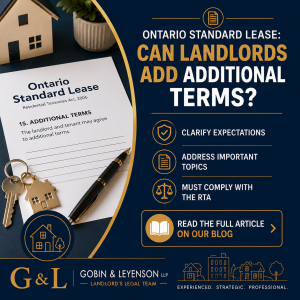
Can Ontario landlords add additional terms to the Standard Lease? Learn how lawful lease clauses may help clarify expectations and reduce disputes.
Why This Issue Matters
Many residential tenancy disputes arise not because either party intended to create a problem, but because expectations were never clearly documented at the outset.
Questions frequently arise regarding:
- Insurance requirements;
- Utility responsibilities;
- Parking arrangements;
- Internet services;
- Shared areas of a property;
- Occupancy expectations;
- Property inspections;
- Rules governing common areas;
- Move-in and move-out procedures; and
- Responsibilities relating to appliances and amenities.
When expectations are clearly documented at the beginning of the tenancy, misunderstandings may be reduced and disputes may become easier to resolve. A carefully drafted lease can often serve as a valuable risk-management tool.
The Ontario Standard Lease Is Only the Starting Point
The Standard Lease contains a section specifically permitting additional terms. ² However, not every clause that a landlord wishes to include will be enforceable. The Residential Tenancies Act contains numerous provisions that prohibit contracting out of tenant rights. ³
As a result, a clause may appear reasonable, yet still be unenforceable if it conflicts with the legislation. For example, a provision that attempts to remove a tenant’s statutory rights or expand a landlord’s legal remedies beyond what is permitted by law may not be upheld. This is why the drafting of additional terms often requires careful consideration. The objective is not simply to add more clauses. The objective is to add clauses that are lawful, practical, and capable of being relied upon if a dispute later reaches the Landlord and Tenant Board or a court.
Examples of Topics Commonly Addressed Through Additional Terms
Every rental property is different. A detached house may present different issues than a condominium unit, basement apartment, multiplex, or purpose-built rental building. As a result, additional terms are often tailored to the specific property and tenancy. Examples of subjects that landlords may consider addressing include:
Insurance Requirements
Many landlords choose to address tenant insurance obligations within their lease documentation. Clear language may assist in setting expectations regarding liability coverage and contents insurance.
Utility Responsibilities
Additional terms are often used to clarify:
- Which utilities are included in rent;
- Which utilities are the tenant’s responsibility;
- How utility reimbursements will occur; and
- What documentation may be required.
Parking Arrangements
Where parking is provided, additional terms may address:
- Assigned parking spaces;
- Vehicle identification;
- Visitor parking;
- Storage restrictions; and
- Parking-related rules.
Shared Areas
For duplexes, triplexes, rooming houses, and other multi-unit properties, it may be helpful to clearly identify:
- Exclusive-use areas;
- Shared-use areas; and
- Areas that are not included in the tenancy.
Internet and Additional Services
Where services such as internet access are provided, additional terms may clarify the scope of the service being offered and establish expectations regarding its use.
Move-In and Move-Out Procedures
Some landlords choose to document procedures relating to:
- Incoming inspections;
- Outgoing inspections;
- Keys and access devices;
- Property condition reports; and
- Surrender of possession.
Rules and Property Management Expectations
Many residential complexes have rules relating to the use of common areas, waste disposal, parking, safety, noise, smoking, and other operational matters. Properly drafted rules may assist in promoting consistent expectations throughout the property.
Legal Decision on the Issue
Facts
In Montgomery v. Van, the Divisional Court considered the effect of provisions contained within a residential tenancy agreement and the extent to which parties may rely upon contractual terms where the Residential Tenancies Act governs the tenancy. ⁴
The Decision
The Court confirmed an important principle that appears throughout Ontario residential tenancy law: parties cannot contract out of rights and obligations established by the Residential Tenancies Act. ⁵ Where a lease provision conflicts with the legislation, the legislation prevails.
Why the Decision Matters
The decision serves as an important reminder for Ontario landlords. Adding additional terms to a lease is not simply a matter of drafting language that appears beneficial. The clause must also be consistent with the Residential Tenancies Act and other applicable law. A provision that is unenforceable may create a false sense of security and may provide little assistance if a dispute ultimately reaches the Landlord and Tenant Board. For that reason, many landlords choose to have additional terms reviewed before they are incorporated into a lease package.
Proactive Lease Drafting Can Save Time and Money
Many landlords focus significant attention on screening prospective tenants. Tenant screening is important. However, the tenancy agreement itself is equally important. A well-prepared lease package may help:
- Clarify expectations;
- Reduce misunderstandings;
- Improve record-keeping;
- Support future enforcement efforts;
- Assist with property management; and
- Reduce the likelihood of disputes.
The cost of addressing issues before a tenancy begins is often significantly lower than attempting to resolve disputes after they arise.
Practical Considerations for Ontario Landlords
Before using additional lease terms, landlords may wish to consider:
- Whether the clause is permitted by the Residential Tenancies Act;
- Whether the clause is tailored to the specific property;
- Whether the wording is clear and unambiguous;
- Whether the clause could reasonably be enforced if challenged;
- Whether the clause conflicts with any statutory tenant rights; and
- Whether the lease package has been professionally reviewed.
A carefully drafted lease should not merely contain more clauses. It should contain appropriate clauses that are lawful, understandable, and relevant to the tenancy.
Conclusion
The Ontario Standard Lease provides the foundation for most residential tenancies in Ontario. However, it is often only the beginning of the tenancy agreement. Lawful additional terms may help landlords clarify responsibilities, reduce misunderstandings, and proactively address issues that commonly arise during residential tenancies.
Because not every clause will be enforceable, landlords may benefit from obtaining professional guidance before relying upon additional lease provisions. A proactive approach at the beginning of a tenancy may help avoid costly disputes later.
Disclaimer
This article is provided for general informational purposes only and does not constitute legal advice. Every situation is unique and the outcome of any particular matter will depend upon its specific facts and circumstances. Reading this article does not create a paralegal-client, lawyer-client, or solicitor-client relationship. If you require legal advice regarding your situation, you should obtain professional legal assistance.
Footnotes
- Residential Tenancies Act, 2006, SO 2006, c 17, s. 12.1.
- Ontario Standard Form of Lease, Clause 15.
- Residential Tenancies Act, 2006, SO 2006, c 17, s. 4.
- Montgomery v. Van, 2009 CanLII 10384 (ON SCDC).
- Montgomery v. Van, 2009 CanLII 10384 (ON SCDC).